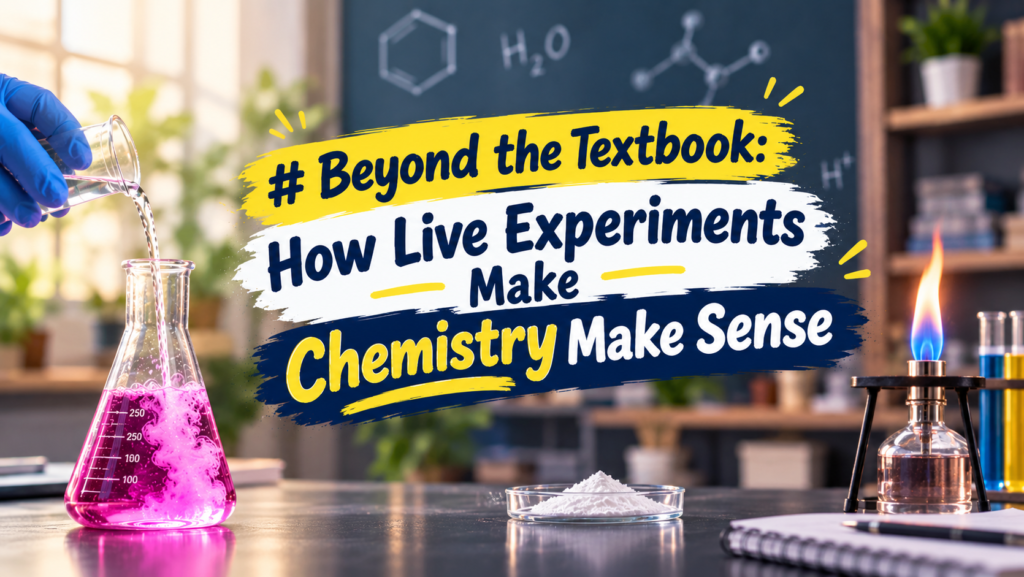
Chemistry is often introduced through formulas, equations, reactions, periodic tables, and lengthy chapters. For many students, however, the real challenge begins when they try to understand what actually happens when two substances interact. Why does one reaction produce heat? Why does a colour suddenly change? What happens when an acid reacts with a base? Why does one substance behave differently when mixed with another?
These questions become much easier to understand when Chemistry is not limited to textbooks and classroom explanations.
At Dr. Madhuresh Chemistry Classes, Chemistry is approached as a subject that students can see, observe, question, and understand through practical demonstrations and live experiments. Instead of simply telling students what happens in a reaction, the concept can be connected with what they actually see happening in front of them.
That practical approach can turn an ordinary Chemistry lesson into an experience that students remember.
1.Chemistry Is More Than Formulas and Equations
A Chemistry chapter may contain dozens of formulas, reaction mechanisms, properties, and equations. Memorising them may help students prepare for an examination, but understanding the reason behind a reaction creates a much stronger foundation.
Consider a simple acid-base reaction. A student may remember an equation from a textbook, but the learning becomes more meaningful when they understand what happens when the substances interact, what changes can be observed, and why those changes occur.
This is where practical demonstrations become valuable. Instead of Chemistry being something students only read, it becomes something they can observe and connect with a real phenomenon.
2.What Happens When Chemistry Comes Alive?
Imagine a teacher explaining a reaction and then performing it in front of the class. Students are not just looking at a written equation anymore. They can observe changes taking place and immediately connect those changes with the concept being discussed.
A reaction may involve:
- A visible colour change
- Formation of gas
- Temperature change
- Formation of a new substance
- A change in physical appearance
- A visible reaction between different substances
Each observation can become a question. Why did this happen? What caused this change? What would happen if another substance were used?
These questions encourage students to think beyond memorisation and develop scientific curiosity.
3.Understanding Acids, Bases and Their Effects
Acids and bases are fundamental parts of Chemistry, but students often learn their properties as lists of points. Acids have certain properties. Bases have certain properties. Acids react with particular substances. Bases react differently.
But when students see these concepts demonstrated practically, the difference becomes easier to visualise. A live demonstration can help students understand not only what an acid or base is, but also how its properties influence the reaction.
The important part is not simply watching something happen — it’s understanding why it happened.
That “why” is what transforms an experiment into Chemistry learning.
4.One Reaction Can Lead to Many Questions
The most interesting part of practical Chemistry is that one reaction does not necessarily end with one answer. It can create a chain of questions: What if the quantity is changed? What if another substance is added? Will the same reaction happen? Will the colour change remain the same? Will the temperature change? Will the product be different?
This kind of thinking develops a scientific mindset. Students begin to understand that Chemistry is not just about remembering a reaction from a book. It is about understanding relationships between substances and predicting what may happen under different conditions.
5.From “What Happens?” to “Why Does It Happen?”
There is a major difference between knowing the result of a reaction and understanding the reaction. A student may know: “This reaction produces this result.” But a deeper understanding asks: “Why does this result occur?”
That second question is extremely important for students preparing for competitive examinations such as JEE and NEET, where conceptual clarity plays an important role.
Practical demonstrations can provide a visual starting point for these discussions. Students first observe the phenomenon and then connect the observation with the underlying Chemistry — making the concept easier to relate to instead of treating it as an isolated fact.
6.Learning Through Observation Makes Concepts More Memorable
Students remember experiences differently from lines written in a notebook. When a reaction is performed live, students can associate the concept with something they actually saw. Instead of simply reading that a particular reaction produces a visible change, they can watch that change happen and then understand the Chemistry responsible for it.
Observation→Question→Explanation→Concept
This combination can make learning more engaging. It also gives students a reason to stay curious about what comes next.
7.Chemistry Can Be Fascinating When Students Are Allowed to Ask Questions
A good Chemistry learning environment should not make students afraid of asking questions. Practical demonstrations naturally encourage curiosity.
A student may ask, “Why did this happen?” Another may ask, “What if we use something else?” Someone else may wonder, “Will the same thing happen every time?”
These questions are not distractions from Chemistry. They are part of learning Chemistry. When students start questioning a reaction instead of simply memorising it, they begin developing a deeper understanding of the subject.
8.The Teacher Becomes More Than Someone Who Explains a Chapter
A Chemistry teacher can do much more than complete a syllabus. By demonstrating reactions and connecting them with concepts, a teacher can help students understand how the subject works beyond the textbook. This approach allows the teacher to explain what is happening, why it is happening, which substances are involved, what changes can be observed, what factors can affect the reaction, what concept the reaction demonstrates, and how students can connect it with their syllabus.
The experiment becomes the starting point, while the explanation builds the actual concept.
9.Making Chemistry Easier Without Making It Less Scientific
Making Chemistry interesting does not mean reducing it to entertainment. The real purpose of an experiment is to make the scientific concept easier to understand.
Students should not only think, “That experiment was amazing.” They should also leave with, “Now I understand why that happened.”
That combination of curiosity and conceptual understanding is what makes practical learning meaningful.
10.From Classroom Demonstrations to Stronger Conceptual Understanding
Chemistry becomes much more approachable when students can connect three things: theory, observation, and explanation.
The theory tells students what should happen. The experiment allows them to observe what happens. The explanation tells them why it happens. Together, these three elements can create a much stronger learning experience.
For students preparing for boards, JEE, NEET and other academic examinations, this kind of conceptual approach can help them look at Chemistry from a different perspective — seeing the logic behind a reaction instead of just memorising it.
11.Why Practical Chemistry Leaves a Different Impression
A textbook can tell students that a reaction takes place. A teacher can explain the mechanism. But watching the reaction happen in real time creates another layer of understanding — something concrete to connect with the theory.
That is why practical demonstrations can make even familiar Chemistry topics feel fresh and interesting. The goal is not to replace textbooks, equations, or problem-solving. It is to make those things easier to understand.
12.Why Students Remember Live Experiments Long After the Lesson Is Over
There is a reason students can forget a formula within a few days but still remember an experiment they watched months, even years, ago.
When a reaction is only read from a textbook, the brain stores it as information. But when a reaction is actually seen — the fizzing, the colour change, the sudden heat, the smell, the sound — the brain stores it as an experience. And experiences stay much longer than information does.
This is why live demonstrations create a different kind of memory altogether. A student does not simply recall “what the reaction was.” They recall the entire moment: watching the substance being added, noticing the sudden change, wondering why it happened, hearing the explanation, and connecting it to the concept in their textbook.
Because the learning happens in this sequence — seeing first, questioning next, understanding after — the concept gets attached to a real memory instead of a written line. And a memory is much harder to forget than a fact. This is also why students who have watched an experiment once can often explain the concept years later, even if they don’t remember the exact chapter or page number. They remember the moment, and the concept comes back attached to it.
Some other reasons live experiments stay in memory longer:
- →The reaction involves more than one sense — sight, sometimes smell, sometimes sound — which makes the brain register it more strongly than plain text
- →The unexpectedness of an observation, like a sudden colour change or gas formation, creates a small element of surprise, and surprises are remembered more easily than routine information
- →Asking “why did this happen” right after seeing it creates an emotional connection to the concept, not just an academic one
- →Group discussions and questions during a live demonstration make the learning social, and social memories tend to last longer than solitary reading
- →The explanation given immediately after an observation gets linked to that observation permanently, so recalling one automatically brings back the other
“Oh, I remember — this is the one where the solution turned blue and started bubbling.” The concept survives because the experience never really left.
For young learners especially, this kind of memory is invaluable. It means the Chemistry they learn today does not stay limited to marks in an exam. It becomes part of how they understand the world — something they can recall naturally, without needing to “revise” it the way they would a memorised paragraph.
13.Chemistry Is Not Just Something to Study — It Is Something to Explore
Every reaction can lead to another question. Every observation can lead to another concept. And every concept can lead to a deeper understanding of Chemistry.
That is the idea behind making Chemistry more practical, visual, and engaging.
At Dr. Madhuresh Chemistry Classes, the focus is not only on explaining Chemistry but also on helping students experience the subject through demonstrations and experiments that connect classroom concepts with visible scientific phenomena. The institute’s Instagram describes its approach as learning science through simple and fascinating experiments while making complex concepts easier to understand.
When students can see Chemistry happening in front of them, the subject can become more than a collection of formulas and reactions. It becomes something they can observe, question, understand and remember.
Chemistry becomes easier when you don’t just learn what happens — you understand why it happens.
Learn Chemistry With Curiosity
If you want to build stronger Chemistry concepts through clear explanations, practical demonstrations, and an approach that makes complex topics easier to understand, explore Dr. Madhuresh Chemistry Classes.
WEBSITE : drmadhuresh.com
LOCATION : Near, 2 LIC colony, Jaleshwar Mahadev Mandir, Kendriya Vidyalaya Road, Kankarbagh