Name reactions are the part of organic chemistry that students dread the most. There are dozens of them, the names look alike, and the reagents have a way of vanishing from your head the night before the exam.
Here is something we tell every batch in the first month: a name reaction is not a fact to memorise, it is a story with three parts. There is a starting compound, there is a reagent that does something specific to it, and there is a reason the reaction stops where it does. Once you understand that story, you don’t need to cram it.
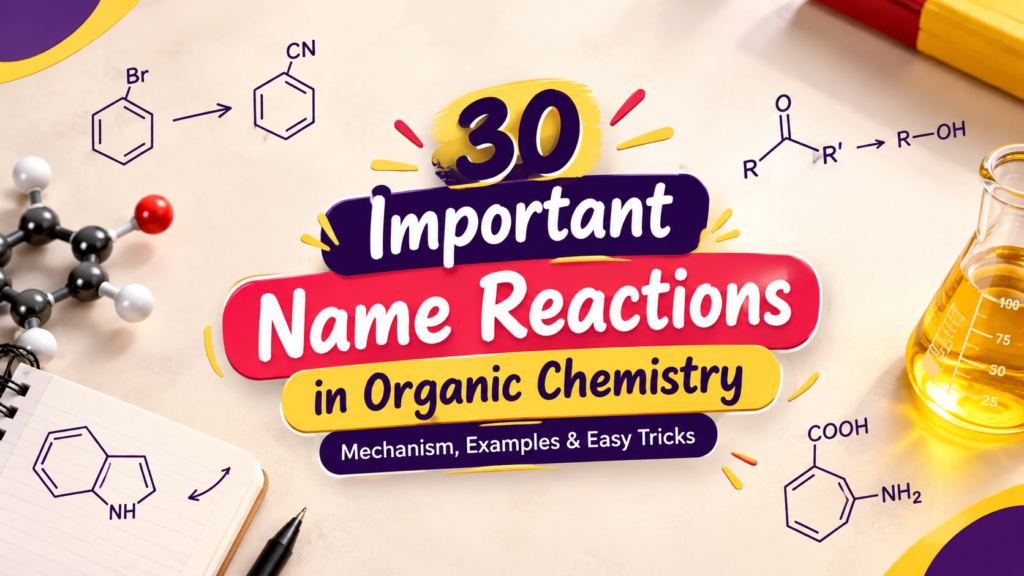
Quick answer: The most important name reactions for NEET, JEE Main and Class 12 boards come from five chapters: Aldehydes & Ketones, Haloalkanes & Haloarenes, Alcohols-Phenols-Ethers, Carboxylic Acids, and Amines. This guide covers 30 of them with the reagent, the reaction, the mechanism in simple words, and the exam trap to avoid.
Part 1: Aldehydes and Ketones
1. Aldol Condensation
Reagent: Dilute NaOH or dilute HCl
Works on: Aldehydes or ketones that have at least one α-hydrogen
Reaction:
2 CH₃CHO → (dil. NaOH) → CH₃CH(OH)CH₂CHO (3-hydroxybutanal)
On heating: CH₃CH=CHCHO (but-2-enal) + H₂O
Theory: The hydrogen on the carbon next to C=O (the α-carbon) is slightly acidic. The base removes it and forms an enolate ion. This enolate attacks the carbonyl carbon of a second molecule and joins the two. The product is a β-hydroxy aldehyde, which is why it’s called “aldol” (aldehyde + alcohol). Heating removes water and you get a conjugated α,β-unsaturated compound.
Exam point: No α-hydrogen, no aldol. Formaldehyde and benzaldehyde cannot do it.
2. Cannizzaro Reaction
Reagent: Concentrated NaOH or KOH
Works on: Aldehydes with no α-hydrogen
Reaction:
2 HCHO + conc. NaOH → CH₃OH + HCOONa
2 C₆H₅CHO + conc. NaOH → C₆H₅CH₂OH + C₆H₅COONa
Theory: The hydroxide ion attacks the carbonyl carbon. The intermediate then gives away a hydride ion (H⁻) to another aldehyde molecule. So one molecule loses hydride and gets oxidised to the acid salt, while the other gains hydride and is reduced to the alcohol. This is a disproportionation reaction.
Exam point: Aldol needs α-H. Cannizzaro needs the absence of α-H. They are mirror images of each other, and examiners love to test both in the same paper.
3. Claisen–Schmidt (Crossed Aldol) Condensation
Reagent: NaOH
Reaction:
C₆H₅CHO + CH₃COCH₃ → C₆H₅CH=CHCOCH₃ + H₂O (benzalacetone)
Theory: This is an aldol reaction between two different carbonyl compounds. Benzaldehyde has no α-H so it can only be attacked. Acetone has α-H so it forms the enolate and does the attacking. That is why you get one main product and not a messy mixture.
Exam point: If the question gives benzaldehyde and a ketone with NaOH, think chalcone or benzalacetone type products.
4. Benzoin Condensation
Reagent: Alcoholic KCN
Reaction:
2 C₆H₅CHO → (KCN, ethanol) → C₆H₅CH(OH)–CO–C₆H₅ (benzoin)
Theory: The cyanide ion adds to benzaldehyde and temporarily reverses the polarity of the carbonyl carbon, so it now behaves as a nucleophile instead of an electrophile. This carbon attacks a second benzaldehyde molecule. After cyanide leaves, you get the α-hydroxy ketone.
Exam point: Works for aromatic aldehydes. Aliphatic aldehydes don’t give benzoin.
5. Perkin Reaction
Reagent: Acid anhydride + sodium salt of the same acid, around 453 K
Reaction:
C₆H₅CHO + (CH₃CO)₂O → (CH₃COONa, heat) → C₆H₅CH=CHCOOH (cinnamic acid)
Theory: The acetate ion pulls an α-hydrogen from the anhydride to form a carbanion. This attacks the aldehyde, and after dehydration and hydrolysis you get an α,β-unsaturated carboxylic acid.
Exam point: Benzaldehyde → cinnamic acid is the most common question.
6. Haloform Reaction (Iodoform Test)
Reagent: I₂ + NaOH (or NaOI)
Works on: Methyl ketones (CH₃CO–R) and alcohols with CH₃CH(OH)– group
Reaction:
CH₃COCH₃ + 3I₂ + 4NaOH → CHI₃ ↓ + CH₃COONa + 3NaI + 3H₂O
Theory: The three hydrogens of the methyl group are replaced by iodine one after another, each step making the next one easier. The CI₃ group then becomes a good leaving group, and hydroxide attacks the carbonyl carbon. The result is the carboxylate salt and iodoform (yellow precipitate with a medicinal smell).
Exam point: Ethanol gives iodoform. Methanol does not. Acetaldehyde does. Other aldehydes do not.
7. Clemmensen Reduction
Reagent: Zn–Hg amalgam + conc. HCl
Reaction: R–CO–R’ → R–CH₂–R’
Theory: The carbonyl group is reduced all the way to CH₂ on the zinc surface in a strongly acidic medium.
Exam point: Used when the molecule can handle acid but not base.
8. Wolff–Kishner Reduction
Reagent: Hydrazine (NH₂NH₂), then KOH in ethylene glycol at about 473 K
Reaction: R–CO–R’ → R–CH₂–R’ + N₂
Theory: The ketone first forms a hydrazone. Under strong base and heat, the hydrazone loses nitrogen gas, and the carbon picks up hydrogen.
Exam point: Clemmensen is acidic and Wolff–Kishner is basic. If the molecule has an acid-sensitive group, choose Wolff–Kishner.
Part 2: Preparation of Aldehydes
9. Rosenmund Reduction
Reagent: H₂, Pd supported on BaSO₄ (partially poisoned)
Reaction: RCOCl + H₂ → RCHO + HCl
Theory: Normally hydrogen would reduce an acyl chloride all the way to an alcohol. The BaSO₄ (often with a little sulphur or quinoline) poisons the catalyst just enough to stop the reaction at the aldehyde stage.
Exam point: The word “poisoned catalyst” is the answer to “why does it stop at aldehyde?”
10. Stephen Reduction
Reagent: SnCl₂ + HCl, followed by hydrolysis
Reaction: RCN → RCH=NH·HCl → (H₃O⁺) → RCHO
Theory: The nitrile is partly reduced to an imine hydrochloride, which hydrolyses to the aldehyde.
Exam point: Nitrile + tin = aldehyde. If the question uses DIBAL-H instead, the end result is the same.
11. Etard Reaction
Reagent: CrO₂Cl₂ in CS₂ or CCl₄, then H₃O⁺
Reaction: C₆H₅CH₃ → C₆H₅CHO
Theory: Chromyl chloride forms a brown complex with toluene. Hydrolysing this complex gives benzaldehyde and stops before benzoic acid forms.
Exam point: Mild oxidation of toluene to benzaldehyde. A strong oxidant like KMnO₄ would give benzoic acid.
12. Gattermann–Koch Reaction
Reagent: CO + HCl with anhydrous AlCl₃ and CuCl
Reaction: C₆H₆ + CO + HCl → C₆H₅CHO + HCl
Theory: CO and HCl together generate a formyl cation (HCO⁺), which attacks the benzene ring in an electrophilic substitution. Formyl chloride (HCOCl) itself is unstable, which is why the mixture is used instead.
Exam point: Works on benzene and alkylbenzenes. It does not work well on phenols or phenolic ethers.
Part 3: Haloalkanes, Haloarenes and Friedel–Crafts
13. Finkelstein Reaction
Reagent: NaI in dry acetone
Reaction: R–Cl (or R–Br) + NaI → R–I + NaCl ↓
Theory: This is a classic SN2 reaction. NaI dissolves in acetone, but NaCl and NaBr do not, so they precipitate out. Removing the product from the solution pushes the equilibrium forward.
Exam point: Finkelstein = iodides. Works best with primary halides.
14. Swarts Reaction
Reagent: AgF, Hg₂F₂, CoF₂ or SbF₃
Reaction: CH₃Br + AgF → CH₃F + AgBr
Theory: Direct fluorination is too violent, so metal fluorides are used to swap a heavier halogen for fluorine in a controlled way.
Exam point: Swarts = fluorides. Finkelstein = iodides. One line, never confused again.
15. Wurtz Reaction
Reagent: Sodium metal in dry ether
Reaction: 2 CH₃CH₂Br + 2Na → CH₃CH₂CH₂CH₃ + 2NaBr
Theory: Sodium forms an organosodium compound (R–Na) with one molecule of halide, which then attacks the second halide and joins the two alkyl groups.
Exam point: Doubles the carbon chain. Using two different halides gives a mixture of products, so it is only practical for symmetrical alkanes. Methane cannot be made by this method.
16. Wurtz–Fittig Reaction
Reagent: Sodium in dry ether
Reaction: C₆H₅Br + CH₃Br + 2Na → C₆H₅CH₃ + 2NaBr
Theory: The same idea as Wurtz, but one partner is an aryl halide. This gives an alkylbenzene.
Exam point: Two aryl halides with sodium is the Fittig reaction, giving biphenyl.
17. Friedel–Crafts Alkylation
Reagent: R–Cl with anhydrous AlCl₃
Reaction: C₆H₆ + CH₃Cl → C₆H₅CH₃ + HCl
Theory: AlCl₃ pulls the chloride off the alkyl halide to make a carbocation, which attacks benzene (electrophilic aromatic substitution).
Exam point: Two problems to remember. Carbocations rearrange (n-propyl chloride gives isopropylbenzene), and the product is more reactive than benzene so polyalkylation happens.
18. Friedel–Crafts Acylation
Reagent: RCOCl or (RCO)₂O with anhydrous AlCl₃
Reaction: C₆H₆ + CH₃COCl → C₆H₅COCH₃ + HCl
Theory: AlCl₃ generates an acylium ion (RCO⁺), which attacks benzene. The ketone group deactivates the ring, so the reaction stops after one substitution.
Exam point: No rearrangement, no polysubstitution. Neither alkylation nor acylation works on nitrobenzene or aniline.
Part 4: Alcohols, Phenols and Ethers
19. Williamson Ether Synthesis
Reagent: Sodium alkoxide + alkyl halide
Reaction: CH₃CH₂ONa + CH₃Br → CH₃CH₂OCH₃ + NaBr
Theory: An SN2 reaction. The alkoxide acts as the nucleophile and attacks the alkyl halide from the back side.
Exam point: Use a primary alkyl halide. A tertiary halide gives an alkene by elimination, because the alkoxide is also a strong base. To make an unsymmetrical ether, put the bulky group on the alkoxide side.
20. Reimer–Tiemann Reaction
Reagent: CHCl₃ + aqueous NaOH, about 340 K, then acid
Reaction: Phenol → salicylaldehyde (ortho major, para minor)
Theory: Chloroform and a strong base generate dichlorocarbene (:CCl₂), a highly electrophilic species. The phenoxide ion, which is very electron-rich, attacks it, mainly at the ortho position. Hydrolysis then converts the –CHCl₂ group to –CHO.
Exam point: With CCl₄ in place of CHCl₃, you get salicylic acid instead.
21. Kolbe’s Reaction
Reagent: Sodium phenoxide + CO₂ (about 400 K, 4–7 atm), then H⁺
Reaction: C₆H₅ONa + CO₂ → sodium salicylate → salicylic acid
Theory: Carbon dioxide is a weak electrophile, and the phenoxide ring is electron-rich enough to attack it. The –COOH group enters at the ortho position.
Exam point: Salicylic acid + acetic anhydride gives aspirin. Linking it to aspirin makes the reaction easy to recall.
Part 5: Carboxylic Acids
22. Hell–Volhard–Zelinsky (HVZ) Reaction
Reagent: X₂ (Cl₂ or Br₂) + red phosphorus
Reaction: CH₃CH₂COOH + Br₂ → (red P) → CH₃CHBrCOOH + HBr
Theory: Phosphorus first converts a little of the acid to an acyl halide. This enolises more easily than the acid itself, and the α-carbon gets halogenated. The acyl halide then exchanges with more acid to give the α-halo acid.
Exam point: Only the α-carbon is halogenated. A carboxylic acid with no α-H will not react.
23. Kolbe Electrolysis
Reagent: Electrolysis of aqueous sodium or potassium salt of a carboxylic acid
Reaction: 2 CH₃COONa + 2H₂O → CH₃–CH₃ + 2CO₂ + H₂ + 2NaOH
Theory: At the anode, the carboxylate ion loses an electron and CO₂, leaving an alkyl free radical. Two radicals combine to form an alkane. Hydrogen is released at the cathode.
Exam point: Not to be confused with Kolbe’s reaction (#21). One uses electricity and gives an alkane. The other uses CO₂ and gives salicylic acid.
Part 6: Amines and Diazonium Salts
24. Hoffmann Bromamide Degradation
Reagent: Br₂ + NaOH (or KOH)
Reaction: RCONH₂ + Br₂ + 4NaOH → RNH₂ + Na₂CO₃ + 2NaBr + 2H₂O
Theory: The amide is brominated on nitrogen, then loses HBr to form an isocyanate (R–N=C=O) after the R group migrates from carbon to nitrogen. Hydrolysis of the isocyanate removes CO₂ as carbonate and leaves the amine.
Exam point: The product amine has one carbon fewer than the amide. Acetamide gives methylamine, and benzamide gives aniline.
25. Gabriel Phthalimide Synthesis
Reagent: Phthalimide + KOH, then alkyl halide, then hydrolysis
Reaction: Phthalimide → potassium phthalimide → N-alkylphthalimide → RNH₂
Theory: The N–H of phthalimide is acidic because it sits between two C=O groups. KOH removes it, and the resulting anion attacks the alkyl halide. Hydrolysis then releases the pure primary amine.
Exam point: Gives only primary aliphatic amines, with no 2° or 3° contamination. It cannot make aromatic amines such as aniline, because aryl halides don’t undergo nucleophilic substitution easily.
26. Carbylamine Reaction
Reagent: CHCl₃ + alcoholic KOH, heat
Reaction: RNH₂ + CHCl₃ + 3KOH → RNC + 3KCl + 3H₂O
Theory: Dichlorocarbene, formed from chloroform and base, reacts with the primary amine to give an isocyanide (carbylamine), which has a strong, foul smell.
Exam point: Works only with primary amines, aliphatic or aromatic. It is the standard test for 1° amines.
27. Hinsberg Test
Reagent: Benzenesulfonyl chloride (C₆H₅SO₂Cl)
| Amine type | Reaction | Product’s behaviour in alkali |
|---|---|---|
| Primary | Gives sulfonamide with an acidic N–H | Dissolves |
| Secondary | Gives sulfonamide with no N–H | Does not dissolve |
| Tertiary | No reaction | Not applicable |
Theory: Primary amines form sulfonamides that still have an N–H, so alkali removes that hydrogen and makes a soluble salt. Secondary amine sulfonamides have no such hydrogen and stay insoluble.
Exam point: Dissolves, doesn’t dissolve, no reaction. That is 1°, 2°, 3°.
28. Sandmeyer Reaction
Reagent: CuCl/HCl, CuBr/HBr or CuCN/KCN
Reaction: C₆H₅N₂⁺Cl⁻ + CuCl → C₆H₅Cl + N₂
Theory: The diazonium group is an excellent leaving group (it departs as nitrogen gas). Copper(I) salts then help introduce Cl, Br or CN in its place.
Exam point: If copper powder with HCl or HBr is used instead of copper(I) salts, it is called the Gattermann reaction.
29. Balz–Schiemann Reaction
Reagent: HBF₄ (fluoroboric acid), then heat
Reaction: ArN₂⁺Cl⁻ + HBF₄ → ArN₂⁺BF₄⁻ ↓ → (heat) → ArF + BF₃ + N₂
Theory: Fluoride cannot be introduced by the Sandmeyer method. Instead, the diazonium fluoroborate precipitates, is filtered, dried and heated. It decomposes to give the aryl fluoride.
Exam point: The only standard route to aryl fluorides from diazonium salts.
30. Azo Coupling
Reagent: Diazonium salt + phenol (pH 9–10) or aniline (pH 4–5)
Reaction: C₆H₅N₂⁺Cl⁻ + C₆H₅OH → p-hydroxyazobenzene (orange dye)
Theory: The diazonium ion is a weak electrophile. It attacks only strongly activated rings like phenols and anilines, usually at the para position, and forms an –N=N– linked azo compound. These are intensely coloured and used as dyes.
Exam point: Medium matters. Phenol needs mild base so it exists as phenoxide. Aniline needs mild acid so that the diazonium ion is not destroyed and the amine is not fully protonated.
Quick Comparison Tables
Table 1: Reactions that are easy to confuse
| Pair | Key difference |
|---|---|
| Aldol vs Cannizzaro | Aldol needs α-H and dilute base. Cannizzaro needs no α-H and concentrated base. |
| Clemmensen vs Wolff–Kishner | Both turn C=O into CH₂. Clemmensen is acidic, Wolff–Kishner is basic. |
| Finkelstein vs Swarts | Finkelstein gives R–I. Swarts gives R–F. |
| Wurtz vs Wurtz–Fittig vs Fittig | Alkyl + alkyl, aryl + alkyl, aryl + aryl. |
| Kolbe’s reaction vs Kolbe electrolysis | CO₂ + phenoxide → salicylic acid vs electrolysis of carboxylate → alkane. |
| Sandmeyer vs Balz–Schiemann | Sandmeyer gives Ar–Cl, Ar–Br, Ar–CN. Balz–Schiemann gives Ar–F. |
| Friedel–Crafts alkylation vs acylation | Alkylation: rearrangement + polysubstitution. Acylation: neither. |
Table 2: Which reaction gives which functional group?
| You want | Use |
|---|---|
| Aldehyde from acyl chloride | Rosenmund |
| Aldehyde from nitrile | Stephen |
| Benzaldehyde from toluene | Etard |
| Benzaldehyde from benzene | Gattermann–Koch |
| Aryl fluoride | Balz–Schiemann |
| Alkyl iodide | Finkelstein |
| Alkyl fluoride | Swarts |
| Amine with one carbon less | Hoffmann bromamide |
| Pure 1° aliphatic amine | Gabriel phthalimide |
| Salicylaldehyde | Reimer–Tiemann |
| Salicylic acid | Kolbe’s reaction |
| α-halo carboxylic acid | HVZ |
Table 3: Named tests used in practical and theory
| Test | Detects | Positive result |
|---|---|---|
| Iodoform (haloform) | CH₃CO– or CH₃CH(OH)– | Yellow precipitate |
| Carbylamine | Primary amine | Foul-smelling isocyanide |
| Hinsberg | Type of amine (1°, 2°, 3°) | Solubility of the sulfonamide in alkali |
| Azo dye | Aromatic primary amine | Orange or red dye |
How to Actually Remember All These
1. Study by chapter, not by alphabet. Don’t learn name reactions in the order of their names. Learn the aldehyde group together, the amine group together. Your brain stores connected facts better.
2. Learn the condition, not just the product. Most wrong answers happen because a student forgets when a reaction works: α-H present or absent, primary or tertiary halide, acidic or basic medium.
3. Revise the pairs. The comparison tables above are not decoration. Revise them the day before the exam.
4. Write, don’t just read. Cover the page and write the reagent and product from memory. Check what you missed. Repeat the next day.
5. Solve questions right after revising. Reactions stay in your head only once you’ve used them in a problem.
Frequently Asked Questions
Which name reactions are most important for NEET?
Aldol, Cannizzaro, Hoffmann bromamide, Gabriel phthalimide, Carbylamine, Sandmeyer, Reimer–Tiemann, Kolbe’s reaction, Wurtz, and the haloform reaction are the ones that keep returning.
Are name reactions important for JEE Main and Advanced?
Yes. In JEE Main they appear as direct product-based questions. In JEE Advanced they form the base of multi-step conversions and reasoning questions.
How many name reactions should I prepare for Class 12 boards?
The reactions in your NCERT chapters on aldehydes and ketones, haloalkanes and haloarenes, alcohols-phenols-ethers, carboxylic acids and amines. This list covers almost all of them.
What is the best way to avoid mixing up name reactions?
Group them by what they produce (aldehydes, amines, fluorides) and revise look-alike pairs side by side using the comparison table.
Do I need to learn the mechanism or just the product?
Learn at least the basic mechanism. It helps you answer “why” questions and it makes the product easy to predict even when the question is twisted.
Why Students Prefer Dr. Madhuresh Chemistry Classes
If you’ve read this far, you already know how much there is to cover in organic chemistry. Reading a blog is a great start, but the real difference comes when someone explains the reasoning behind each reaction, corrects your mistakes in time, and gives you enough practice to make it stick.
At Dr. Madhuresh Chemistry Classes in Kankarbagh, Patna, the focus is on understanding first. Reactions are taught with reasoning instead of lists, so students know why a reagent does what it does. This is also why we use live experiments in class, because seeing a yellow iodoform precipitate form or a diazonium dye appear makes the concept stay far longer than a page of notes ever will.
Students preparing for NEET, IIT-JEE and Class 12 boards get one teacher who handles the full chemistry syllabus (organic, inorganic and physical), so the explanation stays consistent from chapter to chapter. Doubts are cleared in class and not left to pile up, which matters a lot in organic, where one weak chapter can drag down the next.
Practice is built into the programme. Our chemistry test series for NEET and IIT-JEE helps students check their preparation regularly and find weak areas well before the actual exam. And if you can’t attend in person, you can join online or learn through our YouTube channel and app.
If you’d like to see how we teach before deciding, book a free demo class at our Kankarbagh centre, or call 7250949555 / 7370075000.