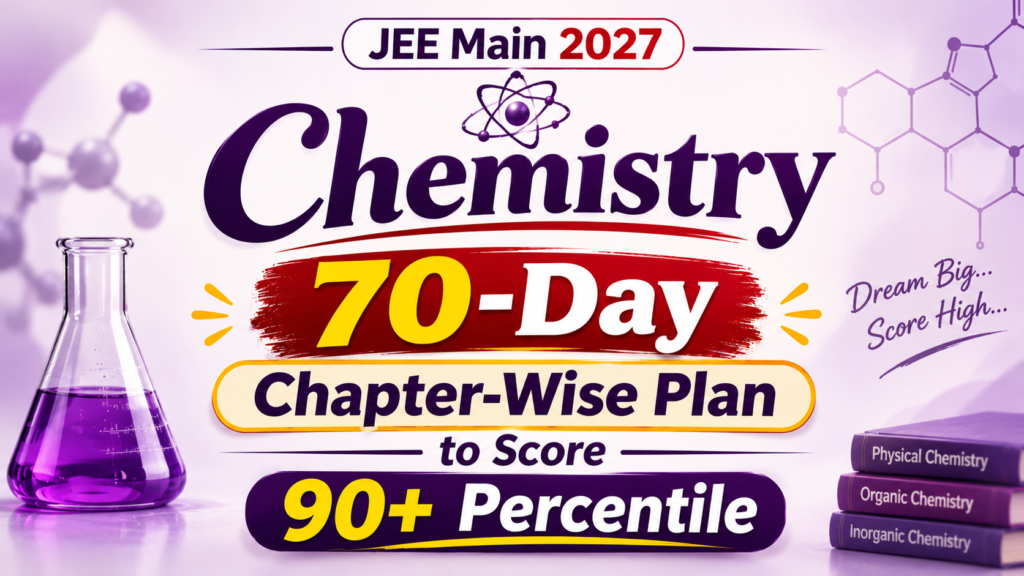
NTA has announced the dates for JEE Main 2027 Session 1. The exam is scheduled for January 22 to 24 and January 28 to 30, with January 31 kept as a buffer date. That leaves you roughly 70 days, which is enough time to transform your chemistry score. The problem is that most students give every chapter equal time, while toppers do the opposite and study by priority. In this guide, you will get a chapter-wise table, easy vs tough chapters and a complete 70-day plan.
Why Chemistry Can Decide Your Percentile
Chemistry is the fastest-scoring subject in JEE Main. If you can finish it accurately in 35 to 40 minutes, you gain valuable extra time for Physics and Maths. That is why toppers aim for 70+ marks in Chemistry, and improving this one subject alone can make a big difference to your overall percentile.
Understanding the Three Parts of JEE Chemistry
JEE Chemistry is really three subjects in one, and each needs a different style of preparation.
| Part | Nature | How to Prepare |
|---|---|---|
| Physical Chemistry | Calculation-based | Build a formula sheet and solve numericals daily |
| Organic Chemistry | Mechanism-based | Understand electron movement instead of memorising; start with GOC |
| Inorganic Chemistry | NCERT-based | Revise NCERT at least 3 times |
Inorganic is the most scoring part for most students. Physical Chemistry follows repeating patterns, so regular practice improves both speed and accuracy.
Chapter-Wise Priority Table
| Chapter | Type | Priority | Difficulty | Best Strategy |
|---|---|---|---|---|
| Mole Concept and Stoichiometry | Physical | High | Medium | Solve 20 numericals daily |
| Chemical Bonding | Inorganic | High | Medium | VSEPR, hybridisation, MOT shortcuts |
| Thermodynamics | Physical | High | Medium | Formula sheet and PYQs |
| Chemical Equilibrium | Physical | High | Medium | Kc, Kp, Le Chatelier |
| Electrochemistry | Physical | High | Medium | Nernst equation, cell numericals |
| GOC | Organic | High | Hard | Concepts first, then problems |
| Hydrocarbons | Organic | High | Medium | Mechanism notes |
| Aldehydes, Ketones and Acids | Organic | High | Medium | Name reactions and conversions |
| Coordination Compounds | Inorganic | High | Medium | CFT, isomerism, nomenclature |
| p-Block Elements | Inorganic | High | Easy | NCERT trends and exceptions |
| d and f Block | Inorganic | Medium | Easy | Properties and colour reasons |
| Periodic Table | Inorganic | Medium | Easy | Trends with exceptions |
| Chemical Kinetics | Physical | Medium | Medium | Order, rate law, half-life |
| Solutions | Physical | Medium | Medium | Colligative properties |
| Biomolecules, Polymers, Everyday Chemistry | Organic | Medium | Easy | Quick NCERT revision |
| Environmental and Practical Chemistry | Mixed | Low to Medium | Easy | Short notes |
Priority is based on chapter importance and question trends. Please confirm the final syllabus on the official NTA website.
Easy Marks vs Tough Chapters
Always finish the chapters that give maximum marks for minimum effort first.
| Category | Chapters | What to Do |
|---|---|---|
| Easy marks (do first) | p-Block, d and f Block, Periodic Table, Biomolecules, Polymers, Environmental Chemistry | Revise NCERT line by line |
| Medium (practice-heavy) | Equilibrium, Thermodynamics, Electrochemistry, Kinetics, Solutions, Coordination | Formula sheet and daily problems |
| Tough (concept-heavy) | GOC, MOT, Organic Conversions | Doubt sessions and repeated revision |
Do not skip the tough chapters, because they connect to many other topics.
Your 70-Day Plan
| Phase | Days | Focus | Daily Target |
|---|---|---|---|
| 1. Foundation Fix | 1 to 20 | Weak chapters, GOC, basic Organic | 2 hrs and 30 PYQs |
| 2. NCERT and Inorganic | 21 to 35 | NCERT Inorganic rounds 1 and 2 | 1.5 hrs and 20 MCQs |
| 3. Physical Boost | 36 to 50 | Numericals, formula sheet, speed | 25 numericals |
| 4. Test Mode | 51 to 65 | Full mocks and chemistry timed tests | 1 mock every 2 days |
| 5. Final Revision | 66 to 70 | Short notes, name reactions, formulas | Light revision, good sleep |
Golden rule: Spend double the time analysing a mock test compared to solving it. Your percentile improves by fixing mistakes.
Daily Chemistry Routine
| Time | Task |
|---|---|
| Morning (45 min) | NCERT Inorganic or Organic revision |
| Afternoon (60 min) | Concept and practice of one chapter |
| Evening (30 min) | PYQs or a timed MCQ set |
| Night (15 min) | Formulas and mistake notebook |
7 Mistakes That Reduce Your Chemistry Score
- Skipping NCERT and relying only on coaching notes
- Memorising Organic reactions without understanding the mechanism
- Not making a formula sheet for Physical Chemistry
- Solving new questions but never revising old mistakes
- Taking mock tests without a time limit
- Leaving Inorganic for the last week
- Starting a new book in the last 30 days
Frequently Asked Questions
When is JEE Main 2027 Session 1?
As per the NTA calendar, it is scheduled for 22 to 24 and 28 to 30 January 2027, with 31 January as a buffer date. Dates can change, so keep checking the official NTA website.
Which chemistry chapters should I start with?
Start with p-Block, Chemical Bonding and Periodic Table, then move to Physical numericals and Organic Chemistry.
Is NCERT enough for JEE Main Chemistry?
For Inorganic, NCERT is the core. For Physical and Organic, you also need extra practice and previous year questions.
How many marks should I target in Chemistry?
With a focused plan, 70+ out of 100 is a realistic target for serious students.
How do I choose the right coaching in Patna?
Look for personal doubt-solving, regular tests and honest feedback, and attend a demo class before deciding.
How to Prepare Physical Chemistry in the Last 70 Days
Physical Chemistry rewards students who practise daily, because the numerical questions follow patterns that repeat every year. Start by writing one formula sheet per chapter, and next to each formula note the conditions where it applies. Most silly mistakes happen when a student uses the right formula in the wrong situation, such as applying an ideal-gas relation where it does not hold.
Solve problems in small timed sets instead of long unplanned sessions. A good target is 10 questions in 20 minutes, then check the answers and rewrite every wrong question in your mistake notebook. Chapters like Mole Concept, Thermodynamics, Equilibrium and Electrochemistry should be revised at least three times before the exam, since they carry a large share of the numerical questions.
| Chapter | Key Points to Master | Common Mistake |
|---|---|---|
| Mole Concept | Limiting reagent, equivalent concept, concentration terms | Mixing up molarity and molality |
| Thermodynamics | First law, enthalpy, entropy, Gibbs energy conditions | Wrong sign convention for work |
| Chemical Equilibrium | Kc and Kp relation, Le Chatelier, degree of dissociation | Forgetting to change units for Kp |
| Ionic Equilibrium | pH of salts and buffers, Ksp, common ion effect | Ignoring water dissociation in dilute solutions |
| Electrochemistry | Nernst equation, Kohlrausch law, electrolysis | Mixing up anode and cathode in cells |
| Chemical Kinetics | Integrated rate laws, half-life, Arrhenius equation | Confusing order with molecularity |
How to Prepare Organic Chemistry in the Last 70 Days
Organic Chemistry becomes easy the moment you stop memorising and start asking why. Every reaction depends on three things: the stability of the intermediate, the nature of the attacking species and the leaving group. If you can answer these three questions, you can predict the product of a reaction you have never seen before.
Begin with GOC and spend at least five days only on inductive effect, resonance, hyperconjugation and acidity-basicity trends. After that, move to Hydrocarbons, Haloalkanes, Alcohols, Aldehydes and Ketones, Carboxylic Acids and Amines in that order. Keep one separate page for name reactions and write the reagent, the condition and the product in a single line, so revision takes minutes instead of hours.
| Topic | What to Focus On | Quick Tip |
|---|---|---|
| GOC | Electronic effects, carbocation stability, acidity order | Draw resonance structures by hand daily |
| Hydrocarbons | Addition mechanisms, Markovnikov and anti-Markovnikov | Learn the reason, not just the rule |
| Haloalkanes and Haloarenes | SN1 versus SN2, E1 versus E2 | Make a comparison table of conditions |
| Alcohols, Phenols, Ethers | Preparation, dehydration, acidity of phenol | Revise conversions in pairs |
| Aldehydes and Ketones | Nucleophilic addition, aldol, Cannizzaro | Know which compounds give which test |
| Amines | Basicity order, diazonium salts, Hinsberg test | Practise conversion chains |
How to Prepare Inorganic Chemistry in the Last 70 Days
Inorganic Chemistry is the fastest way to add marks, and it depends almost entirely on NCERT. Read each chapter slowly, underline every exception, trend and example, and then test yourself without looking at the book. Questions often ask about a single line from NCERT, so even small details such as colours, shapes and oxidation states matter.
Create a short exceptions notebook with one page per chapter. Revise it every alternate day for the first month and every day in the last two weeks. Students who follow this routine usually find that Inorganic becomes their most accurate section in the paper.
| Chapter | Must-Revise Points |
|---|---|
| Periodic Table | Atomic size, ionisation enthalpy and electron gain enthalpy trends with exceptions |
| Chemical Bonding | Hybridisation, shapes, bond order, magnetic behaviour from MOT |
| p-Block Elements | Oxides, oxoacids, anomalous behaviour of the first element in each group |
| d and f Block | Electronic configuration, colour, magnetic moment, lanthanoid contraction |
| Coordination Compounds | IUPAC naming, isomerism, CFT splitting, spin-only magnetic moment |
| Metallurgy and Qualitative Analysis | Extraction principles, salt analysis flow, group reagents |
Weekly Study Schedule for Chemistry
A fixed weekly rhythm removes the daily question of what to study. Use the schedule below and adjust the timings to suit your school or coaching hours, but keep the order the same. Sunday is kept for a full mock test and a proper review, which is the most important session of the week.
| Day | Main Task | Practice |
|---|---|---|
| Monday | Physical Chemistry chapter study | 25 numericals |
| Tuesday | Organic Chemistry concepts and mechanisms | 20 questions and 5 conversions |
| Wednesday | Inorganic NCERT revision | 30 MCQs |
| Thursday | Physical Chemistry practice and formula revision | 25 numericals |
| Friday | Organic reactions and name reaction revision | 20 questions |
| Saturday | Mixed chapter test (chemistry only) | 30 questions in 40 minutes |
| Sunday | Full-length mock test and analysis | Update mistake notebook |
Important Name Reactions and Formulas to Revise Every Week
A short weekly revision list saves you from forgetting high-yield content. Keep these on one page and read them at the start of every Sunday review, so that they stay fresh until exam day.
| Category | Revise These |
|---|---|
| Organic name reactions | Aldol condensation, Cannizzaro, Reimer-Tiemann, Sandmeyer, Gattermann, Hofmann bromamide, Wurtz, Friedel-Crafts |
| Physical formulas | Nernst equation, Arrhenius equation, Henderson-Hasselbalch, Gibbs energy relation, colligative property formulas |
| Inorganic trends | Ionisation enthalpy, electronegativity, oxidising power, acidic strength of oxides |
| Coordination chemistry | EAN rule, CFSE values, spin-only magnetic moment, isomer types |
How to Use Mock Tests and Manage Time in the Exam
Mock tests are useful only when you treat them like the real exam. Sit at a fixed time, set a three-hour timer and avoid looking at notes. After the test, spend more time on analysis than on solving, because every wrong answer shows a gap that you can still fix.
In the actual paper, attempt Chemistry first if it is your strongest subject, and try to finish it within 40 minutes. Do a first quick pass and attempt only the questions you are sure about, then return to the doubtful ones. Never spend more than two minutes on a single chemistry question, because that time is better used elsewhere.
| Mock Test Analysis Step | What to Do |
|---|---|
| Step 1 | Mark every question as correct, guessed correct, wrong or unattempted |
| Step 2 | Find the reason: concept gap, silly mistake, calculation error or time shortage |
| Step 3 | Write wrong questions with the correct method in the mistake notebook |
| Step 4 | Revisit the notebook after two days and again after one week |
Last 7 Days Checklist
The final week is for consolidation, not for learning new topics. Stay calm, keep your routine steady and focus on the material you already know. Tick off each item below as you complete it.
- Revise all formula sheets once
- Revise the exceptions notebook for Inorganic
- Revise name reactions and conversions
- Take two chemistry-only timed tests
- Go through your mistake notebook completely
- Check your admit card, exam centre and travel plan
- Sleep at least 7 hours every night
More Questions Students Ask
Can I improve my chemistry score in just 70 days?
Yes, because Chemistry is the most revision-friendly subject. A student who follows a clear plan, revises NCERT and takes regular mock tests can improve noticeably in this time.
Should I study all chapters or skip some?
Do not skip any high-priority chapter. If time is short, reduce the time on low-weightage chapters but still read their NCERT summary once.
How many mock tests should I take before January?
Aim for at least 12 to 15 full-length mock tests, plus regular chemistry-only timed tests. The quality of your analysis matters more than the number of tests.
What if I am weak in Organic Chemistry?
Go back to GOC first and spend a few days only on electronic effects. Once the basics are clear, Organic reactions start to feel logical instead of heavy.
How does Dr. Madhuresh Chemistry Classes help in the last 70 days?
We provide concept revision, chapter-wise tests, doubt-solving sessions and personal feedback so that students use their remaining time in the most effective way.
Prepare Chemistry with Dr. Madhuresh in Patna
At Dr. Madhuresh Chemistry Classes, we focus on concept clarity, regular test series and personal attention for students preparing for JEE Main, IIT-JEE, NEET and Class 12 boards. Our goal is to make Chemistry simple and turn it into your strongest scoring subject.
| Contact | Details |
|---|---|
| Address | Near 2 LIC Colony, Jaleshwar Mahadev Mandir, Kendriya Vidyalaya Road, Kankarbagh, Patna |
| Phone | 77250949555 / 7370075000 |
| dr.madhureshthakur2204@gmail.com | |
| Website | drmadhuresh.com |
| instagram.com/dr.madhureshchemistryclasses |
Call or WhatsApp today to book your free demo class.