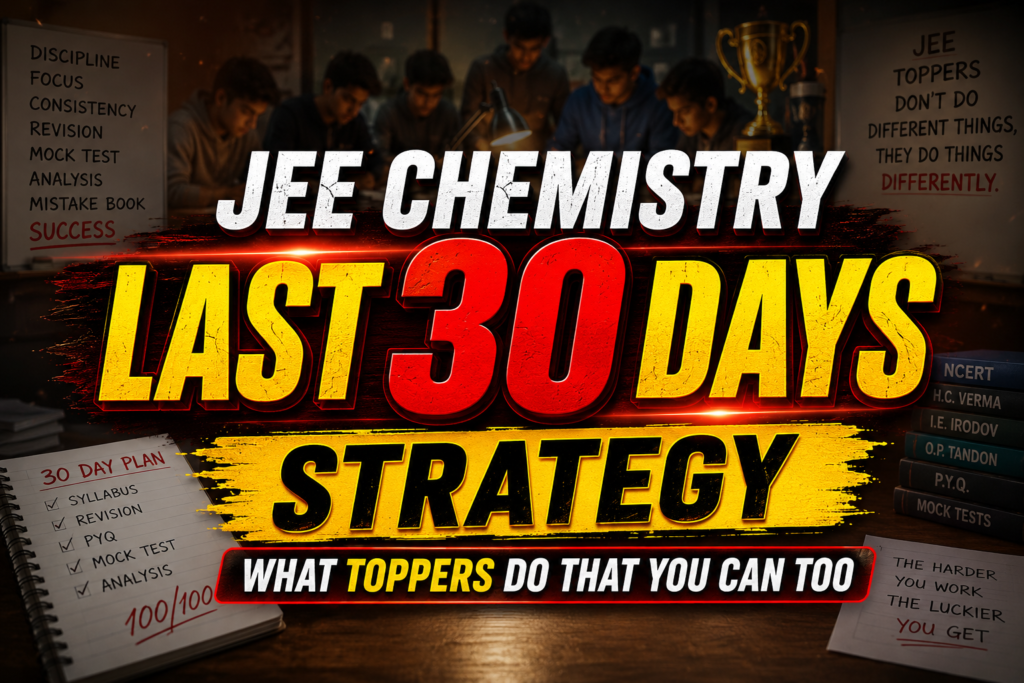
JEE Chemistry Last 30 Days Strategy — What Toppers Do That You Can Too
By Dr. Madhuresh Chemistry Classes | Best Chemistry Coaching in Patna
There’s a moment every JEE aspirant knows too well.
It’s 11 PM. Your phone says “30 days to JEE Mains.” Your notes are everywhere. You’ve studied Organic Chemistry four times but still can’t remember the difference between SN1 and SN2 properly. And somewhere in the back of your mind, a voice whispers — “Is it too late?”
It’s not.
Thirty days is not a short time. It’s exactly enough — if you use it the right way.
At Dr. Madhuresh Chemistry Classes, we have seen hundreds of students walk in with 30 days to go, completely panicked. And we’ve seen many of them crack JEE with excellent scores in Chemistry. The difference between those who did and those who didn’t? Strategy. Not luck.
This blog is that strategy — written plainly, honestly, the way Madhuresh Sir explains it in class.
First, Understand the Game
JEE Chemistry is divided into three sections:
- Physical Chemistry — Numerical-heavy, concept-based. Mole concept, Equilibrium, Electrochemistry, Thermodynamics.
- Organic Chemistry — Mechanism-based. Reactions, named reactions, GOC.
- Inorganic Chemistry — Fact-based. NCERT is your bible here.
Most students make the mistake of spending equal time on all three. Toppers don’t do that. They spend their 30 days based on weightage, their own weak spots, and return on effort.
Here’s a rough guide:
| Section | JEE Weightage | Your Focus |
|---|---|---|
| Physical Chemistry | ~35–40% | High — numericals can be mastered |
| Organic Chemistry | ~30–35% | Medium-High — reactions must be revised |
| Inorganic Chemistry | ~25–30% | High — direct NCERT questions, easy marks |
Week 1 (Days 1–7): Audit and Attack Weak Topics
Do not start revising from page one of your notes. That’s the biggest time-waster in JEE preparation.
Day 1–2: Take a diagnostic test. Solve the last 3 years’ JEE Mains Chemistry papers under timed conditions. Note every question you got wrong or guessed. This is your hit list.
Day 3–7: Attack the weak topics first. Not your strengths — your weaknesses. Because in JEE, every mark counts equally.
For most students, the typical weak areas are:
- Coordination Compounds (Inorganic)
- Electrochemistry and Thermodynamics (Physical)
- GOC — General Organic Chemistry (Organic)
Spend 1–2 days per weak topic. Don’t go deep into theory. Go straight to concept clarity + solved examples + past JEE questions on that topic.
“In our batch, we always tell students — don’t reread the chapter. Solve 20 targeted questions on that chapter. Mistakes will show you exactly what’s missing.” — Madhuresh Sir, Dr. Madhuresh Chemistry Classes
Week 2 (Days 8–16): Rapid Revision of All Three Sections
Now you start the systematic sweep.
Physical Chemistry — Formulae + Numericals Only
Make a single-page formula sheet for each chapter. Don’t write derivations. Write the formula, one example, and the common mistake students make.
Focus on these high-yield chapters:
- Mole Concept
- Chemical Equilibrium and Kp/Kc
- Electrochemistry (Nernst Equation, EMF)
- Chemical Kinetics
- Solutions
Organic Chemistry — The Reaction Map
This is where students lose the most time — trying to memorize everything. Toppers don’t memorize. They understand the electron flow.
Make a reaction map: starting material → reagent → product. For named reactions, know the mechanism in 3 steps, not 10.
Must-know named reactions for JEE:
- Aldol condensation
- Cannizzaro reaction
- Hoffmann bromamide reaction
- Reimer-Tiemann reaction
- Sandmeyer reaction
- Wolf-Kishner and Clemmensen reduction
Inorganic Chemistry — Pure NCERT
Open NCERT Class 11 and 12 Chemistry. Read it like a newspaper. Every bold word, every table, every example. JEE has been directly picking lines from NCERT for Inorganic.
Focus chapters:
- P-block elements (Group 15, 16, 17, 18)
- D and F block
- Coordination Chemistry
- Metallurgy
One chapter per day. Highlighted NCERT + 10 MCQs. That’s it.
Week 3 (Days 17–23): Full Syllabus Mock Tests + Analysis
This week separates toppers from average scorers.
Take one full-length mock test every day. Not just Chemistry — full JEE mock. Because timing matters. How you handle 3 hours of pressure is a skill you must practice.
But the test is only half the work. The other half is analysis.
After every mock:
- Mark every Chemistry question you got wrong.
- Ask — was it a concept error, a calculation mistake, or a time management issue?
- Spend 1 hour fixing only those errors.
Do not move to the next mock until you understand why you got something wrong.
At Dr. Madhuresh Chemistry Classes, our students go through regular chapter-wise tests and full syllabus tests throughout the year — so by the time the 30-day window arrives, they’ve already built this habit. The last month becomes about sharpening, not building from scratch.
Week 4 (Days 24–28): Light Revision + Mental Preparation
You’ve done the hard work. Now protect it.
Days 24–26: Revise only your formula sheets and reaction maps. No new topics. No new books.
Days 27–28: Solve only previous year JEE questions — not new mocks. This keeps your brain in “solve mode” without burning out.
Sleep 7–8 hours. Eat properly. Go for a walk. Your brain consolidates memory during rest — this is not a suggestion, it’s neuroscience.
The 2 Days Before the Exam
- Day Before: Do nothing new. Light revision of your formula sheet. Sleep by 10 PM.
- Morning of Exam: Eat a proper breakfast. Reach the center early. Don’t discuss questions in the parking lot.
The One Mistake That Kills Last-Month Preparation
Students in the last 30 days often try to “complete” topics they haven’t touched all year. A brand-new chapter in 30 days, on top of everything else, causes confusion and panic.
Consolidate what you know. Don’t chase what you don’t.
If you haven’t studied Solid State Chemistry at all, don’t spend 3 days on it now. Spend 1 day on the basic concepts and move on. One or two questions from a weak topic is a fair trade — drowning in an unfamiliar chapter is not.
What Makes the Difference? Honest Answer.
The students who score 80+ in JEE Chemistry are not necessarily smarter. They are:
- More honest about their weak spots
- More consistent with mock tests
- More disciplined about sleep and health in the final weeks
- Less distracted by what others are studying
And most of the time, they’ve had someone beside them — a teacher who knows where they’re going wrong, who gives them targeted feedback, not just notes.
That’s exactly what we do at Dr. Madhuresh Chemistry Classes in Patna. Whether it’s concept-based teaching, doubt-clearing sessions, or regular test analysis — we’ve built our entire system around making Chemistry feel achievable for JEE and NEET students, not overwhelming.
Quick Summary: Your 30-Day Action Plan
| Week | Focus |
|---|---|
| Week 1 | Diagnostic test → identify weak topics → targeted revision |
| Week 2 | Rapid revision of all 3 sections — formulas, reactions, NCERT |
| Week 3 | Daily mock tests + deep analysis of every mistake |
| Week 4 | Light revision only → formula sheets + previous year questions |
| Last 2 days | Rest, confidence, early sleep |
You Can Do This
Thirty days is not a countdown. It’s an opportunity.
Every topper who ever cracked JEE had one thing in common — at some point, they stopped worrying about how much time was left, and started using every hour they had.
That moment can be right now.
Good luck. Chemistry can be your strongest subject in JEE — and we say that from experience.
Dr. Madhuresh Chemistry Classes | Kankarbagh, Patna
- 📞 Call us: 7250949555 / 7370075000
- 🌐 Website: drmadhuresh.com
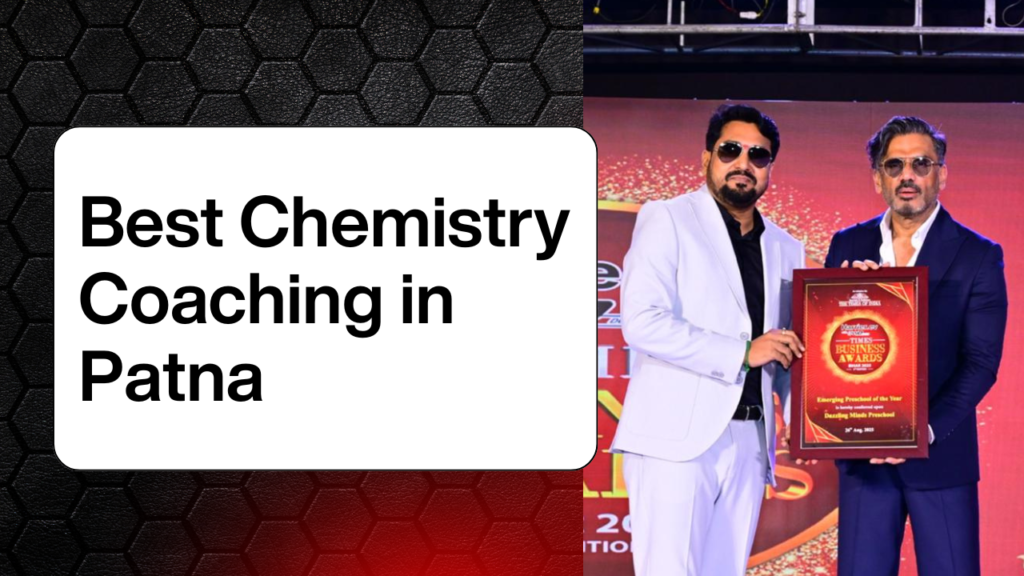
- 🏆 Times Business Award 2025 — Best Chemistry Teacher in Patna
- 🥇 Jagran Edu Solv Award 2025 — Best Chemistry Coaching in Patna